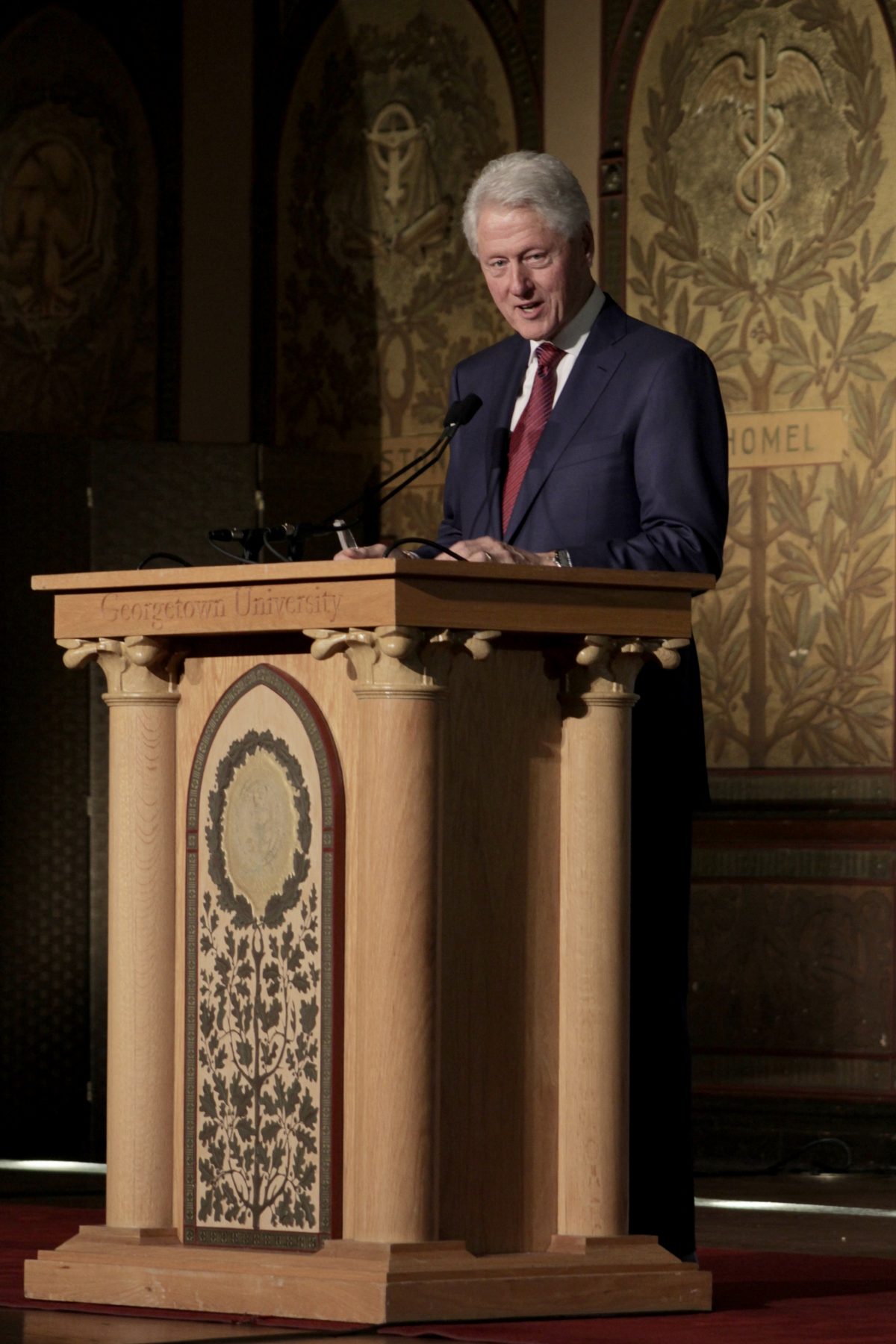
On Tuesday morning, former President Bill Clinton (SFS ’68) came to Gaston Hall to deliver the first of a series of four talks, titled “The Clinton Lectures at Georgetown,” that will occur over a number of years.
He was introduced by University President John De Gioia, who detailed Clinton’s accomplishments, which include the founding of the Clinton Foundation, which partners with NGOs, world leaders, and other institutions in order to foster solutions to problems such as poverty and environmental sustainability.
This is not the first time Clinton has given a series of lectures at Georgetown. In 1991, during his tenure as governor of Arkansas and his first run for president, he delivered a series titled “New Covenant,” about the importance of public service.
Clinton focused on a similar topic for his first talk. “I have reached the firm conclusion that 21st century citizenship requires that we do some public good as part of private life,” he said. ”The future can be better than the present, and each of us has a personal, moral responsibility to make it so.”
Former President Bill Clinton (SFS ’68) is at Gaston Hall this morning, giving the first in a four-part series of talks, titled “The Clinton Lectures at Georgetown”, on public service that will take place over a number of years.
The Morning Digest will provide you with what you need to be prepared for the day: a daily round-up of links, local news, and important events on campus and around D.C.
Today’s weather forecast shows a chilly and cloudy day with a high of 63 degrees.
To masticate today:
Bill Clinton Speaks in Gaston: If you missed his speech in Gaston Hall, look out for our recap on Vox tomorrow.
Study days party ban: 24-hour quiet hours started last night and will last through the end of the semester. The University said it would impose a $50 minimum fine for anyone found in violation.
What to look out for:
Museums feeling effects of sequestration: The sequestration is shutting down parts of the Hirshhorn, African Art Museum, and the Smithsonian Castle. Read more at the Washington City Paper.
New Bikeshare stations: Capital Bikeshare installed two new stations, one on Wisconsin and O and another on Water Street below the freeway.
On Friday afternoon, former President Bill Clinton (SFS ‘68) spoke at Gaston Hall, and reflected on the current economic and political state of the country. His speech was part of the “Clinton-Gore Economics: Understanding the Lessons of the 1990s” symposium, which highlighted economic successes that the speakers attributed to the Clinton administration’s policies and leadership.
The symposium consisted of two panel discussions in addition to Clinton’s keynote speech. The panelists, including top officials and political players during the Clinton administration, addressed the 1993 budget battle and how the Clinton administration treated education, technology, transportation, and other issues within the larger economic plan. They also highlighted the important role that investment played during his administration.
The panelists and the former president also spoke about the country’s balanced budget during his second term, as well as the drops in unemployment numbers and number of people on welfare during his administration, the latter of which decreased from 14.1 million to 5.6 million. They argued that the administration’s policies played a measurable role in changing the economic state in which the country had been during the previous decate.
Clinton, however, noted that the policies made during his administration were not prescriptive. “As you look at the problems that the President faces today, the members of Congress face today, I would like to first state the obvious,” he said. “The particular solution we pursued is not appropriate to this particular moment because the problem is different.”
However, he did say that some of the philosophies that shaped the policies under his administration remain relevant today.
“Abraham Lincoln said that in America, it was good to have wealthy people because it fostered innovation and creativity and effort in the rest of us,” Clinton said. “On the other hand, as an economic matter, we all need to pitch in and do what we can so that those of us who had all of the gains of the last decade [and in the 1980s], just as I did, should make a contribution. That’s a contribution we can make.”
Continuing this year’s parade ofpolitical (or just politically-minded) figures coming to campus, the University announced today via email that former President Bill Clinton will coming to campus this Friday, October 28, for a symposium entitled “Clinton-Gore Economics: Understanding the Lessons of the 1990s.” The event is in conjunction with the William J. Clinton Foundation, which aims at, according to its website, “alleviate poverty, improve global health, strengthen economies, and protect the environment” through partnerships and collaboration.
The event will also include two panel discussions, entitled “The Foundation: The 1993 Budget Fight and the Beginnings of a New Economy,” and “The Bridge: Harnessing the Innovation of the 1990s.” Notable participants include former Secretary of the Treasury Robert Rubin, Vice President Joe Biden’s Chief of Staff Bruce Reed, Former Secretary of Housing and Human Development Henry Cisneros, and Georgetown University President Jack DeGioia.
Apparently, the University has decided to avoid the mob scene that was last year’s Obama line, and has instead chosen to give out tickets by lottery. Students must register for the lottery sometime before 7:00 p.m. tomorrow, and will be notified on Wednesday morning if they have been chosen. Winners are each allowed to bring one guest, who must be a current Georgetown student, staff member, or faculty. The event runs from 12:00 to 2:30 p.m., and anyone who cannot attend the entire event is asked not to register.
If you ever thought keeping in touch with your college roommate is not a good idea, think again.
President Bill Clinton (SFS ’68) recently wrote a preface for his former roommate’s new book.
The Spy Who Jumped Off the Screen, the fourth book byThomas Caplan (’68), will be released next year. The book focuses on a movie star who must use his skills from his time as an intelligence officer to keep nuclear weapons out of the wrong hands.
According to The Washington Post, Clinton writes that the book is a “stylish, involving, utterly contemporary puzzle.”
Caplan’s last book, Grace and Favor, was published in 1998.
“Today we are making history,” said Chinchilla, who lead her closest rival by 22 points in the election. “The Costa Rican people have given me their confidence, and I will not betray it.”
Chinchilla received her master’s degree in public policy at Georgetown in the late ’80s after graduating from the University if Costa Rica. A social conservative who opposes abortion and same-sex marriage, she campaigned on continuing free market policies in Costa Rica. She is the former vice president and public security minister of Costa Rica, and when she takes office in May, she will be the fifth Latin American female president.
Of course, she’ll be one of several presidents to have graduated from Georgetown University. A few in particular come to mind. There’s everyone’s favorite former Harbin resident, of course—Bill Clinton (SFS ’68)—and then there’s Gloria Macapagal Arroyo, the current president of the Philippines. Arroyo is incredibly unpopular and has been linked to the deaths of many Filipino activists and serious corruption scandals. (We like Chinchilla and Clinton a lot more.)
Before her victory, the Global Post‘s Alex Leff wrote that given Costa Rica’s very progressive laws about women in politics, it’s actually a wonder that Chinchilla was about to become only the first female president of that country.
“By law, women must make up 40 percent of a party’s seats in the Legislative Assembly, and by 2014, the law mandates a 50-50 split. That’s well above the world average,” he wrote. “Parties also are obligated to include at least one women on the ballot for their executive branch bids, whether for one of the two vice presidencies or the presidency.”
Bill Clinton (SFS ’68) wasn’t the only president to come through Georgetown’s School of Foreign Service during the ’60s.
Gloria Macapagal Arroyo, the current president of the Philippines, attended the SFS, too. Arroyo didn’t graduate from Georgetown, but she did study here for two years while Clinton was an undergraduate. In fact, Clinton recalled her as his “friend, a long, long time ago” when he attended a ceremony for the Clinton Global Initiative in the Philippines in 2007, and spoke admirably of the tough decisions she had made as the leader of her country.
Like Clinton’s, Arroyo’s term in office has also been marked by legal troubles … and that’s about where the similarities end.
Arroyo, notes every article about her presidency, is incredibly unpopular. She has had to stave off impeachment several times, and her administration is supposed to be behind several serious corruption scandals and the killing or kidnapping of many Filipino activists.
Most recently, “[h]er closest political allies in the southern Philippines were implicated last week in the massacre of 57 people, most of them journalists, in the country’s worst case of election-related violence,” writes Carlos Conde in the New York Times.
So when Arroyo announced on Monday that she would run for a seat in Congress in next year’s elections, it prompted speculation that she was doing so to retain immunity from prosecution, or so that she could use her clout to become prime minister—after creating the position herself.
Arroyo actually does have one last thing in common with Clinton—hers is a political family. A bizarre detail of this story is that the person who currently holds the seat she intends to run for—who said he will step aside for her to run—is Juan Miguel Arroyo, her son.
“If students were not prepared and wanted to avoid the humiliation of being called upon without an answer, they had to approach the professor before class began and plead ‘nolo contendere,’ or no contest,” Shapiro writes.
For his part, Clinton remembers falling asleep in Dr. Giles’s class during a lecture on a U.S. Supreme Court ruling. Dr. Giles said the ruling was easy to understand, “unless, of course, you’re from some hick town in Arkansas,” which sent the class into stitches and startled Clinton awake. Clinton recalls never falling asleep in the class again.
According to his Washington Post obituary Giles graduated from the School of Foreign Service in 1943. He returned to Georgetown after serving in the Army Air Forces in World War II and earned his master’s and doctorate degrees in government in 1945 and 1956. He taught government for 43 years until he retired in 1990. He passed away as a result of congestive heart failure at 89 on October 9.
Vox Populi is the staff blog of the Georgetown Voice, Georgetown University's weekly newsmagazine. Opinions expressed in posts are those of their author alone unless otherwise stated.