Posts Tagged “Congress”

Never underestimate the power of filtered water. In a recent report released by environmental watchdog organization American Rivers, the Potomac River is named number 1 on the list of America’s most endangered rivers of 2012. Five million residents rely on the Potomac for drinking water, and this designation is an attempt to push Congress to ensure that the river does not become too unsafe for public health.

According to American Rivers, the Potomac suffers from urban and agricultural pollution. The report says that the Potomac will eventually become unsafe for drinking water, marine life, and any sort of recreation. Urban development is one of the primary causes of this pollution.

The report demands that Congress stop rolling back regulations on the Environmental Protection Agency and the U.S. Army Corps of Engineers. These organizations work to restore and protect bodies of water under the threat of severe pollution. The Clean Water Act, passed in 1972, is an environmental legislation geared to protecting fresh water, and American Rivers seeks to push Congress to end any bills or regulations hampering this Act.

Ed Merrifield, the Potomac Riverkeeper, said to the Washington Post that after the passage of the Clean Water Act, the quality of the river’s water went up but not drastically enough. “For years, we’ve been reading about the intersex in the fish, up to 80 percent in the places they’ve tested for it,” Merrifield said to the Post. “Yet there hasn’t been much of any action on this in Congress, and it’s very sad because all our drinking water comes from here. The best and safest drinking water comes from healthy rivers and streams.”

Read the rest of this entry »

Comments No Comments »

Last night, Congressman James Clyburn (D-SC), the Assistant Democratic Leader in the House of Representatives, discussed his legislative priorities at a College Democrats event in Healy to a group of largely like-minded Hoyas.

Clyburn began his remarks by commenting on the tireless campaigning that is already taking place ahead of the November elections. He predicted that Congressional business for the rest of the year will be largely toothless continuing resolutions. He also suggested that we may see “the lame duck session to beat all lame duck sessions” once Congress returns to session after the elections.

Considering the current challenges that President Obama and other Democrats face in the upcoming elections, the congressman shared some of his own political philosophy. He explained that first you need to “tell people what you are going to do, then you have to go out and do it, and thirdly you have to tell them what you’ve done.” Lamented the crisis in support President Obama’s healthcare measures are facing, Clyburn said, “we failed to tell the people what we had done.”

Clyburn defended his 10-20-30 plan which designates 10 percent of the budget to be spent on communities where 20 percent of the population has been stuck beneath the poverty line for 30 years. Among other achievements, this program has brought clean water to rural districts that had given up on that basic civil service decades ago.

Read the rest of this entry »

Comments No Comments »

According to 140+ student body presidents, we now “have a deal” on the nation’s debt ceiling.

On Tuesday, both houses of Congress signed off on a measure that, in exchange for evading default and economic calamity, would immediately slash $1 trillion from the federal deficit and direct a new joint committee to find $1.5 trillion in additional cuts. They will temporarily spare Pell Grants with a three-year allocation of $17 billion.

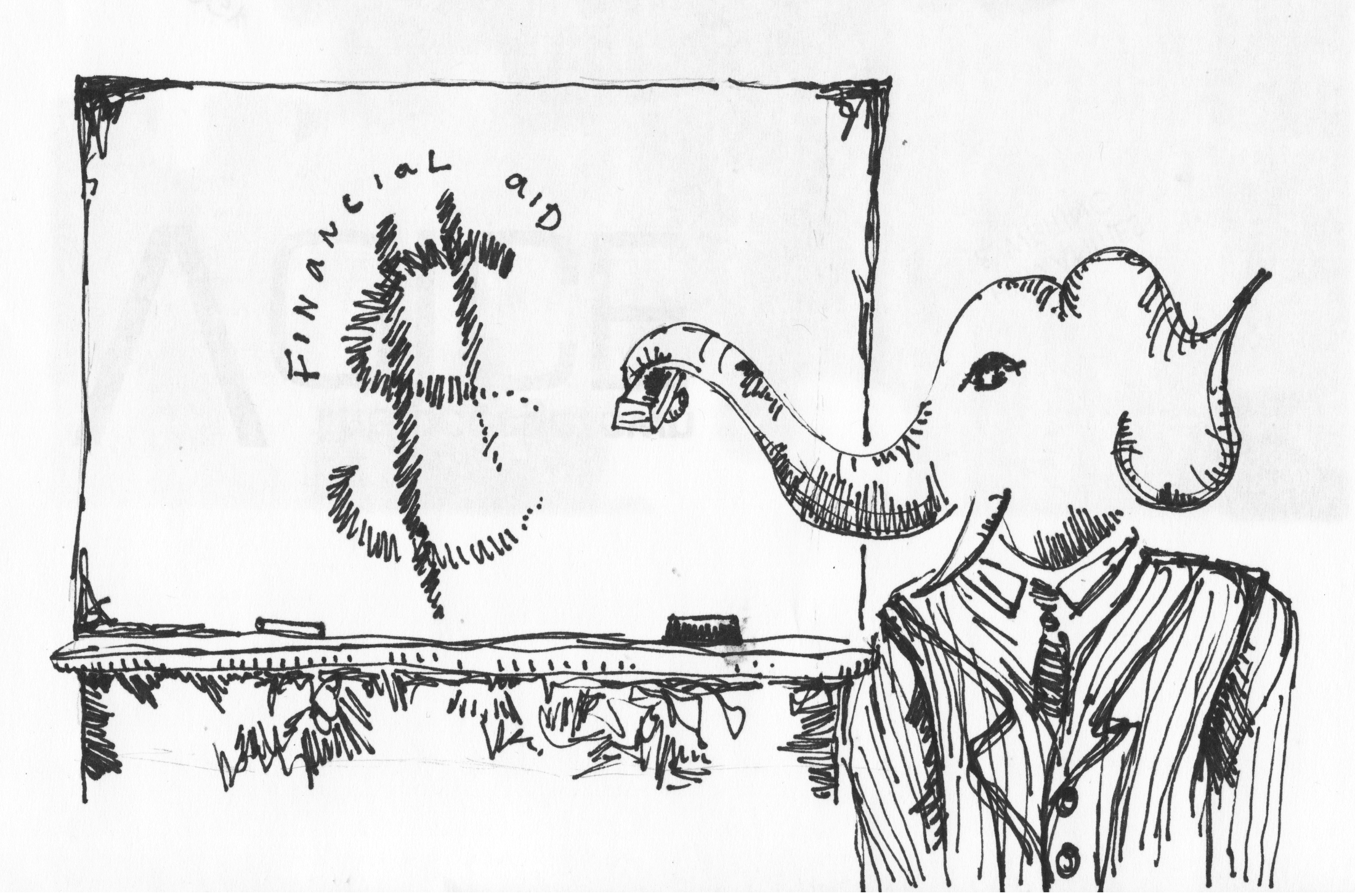
Under the Obama administration, the maximum award under the program increased to $5,550. But this new award represents the smallest share [PDF] of the average college tuition in the program’s history.

Meanwhile, the debt deal eliminates subsidized loans for almost all graduate and professional students. Previously, student loans could not start accruing interest under after graduation. That will no longer be the case, and the CBO estimates that it will save the federal government $21 billion over ten years. Part of these savings will be used to keep Pell Grants afloat.

Image from National Education Association

Comments 2 Comments »

GUSA President Mike Meaney (SFS ’12), former Senator Nick Troiano (COL ’12), and other members of the executive are leading student body presidents from over one hundred different national universities in an effort urging a speedy, “bipartisan” consensus on raising the debt ceiling.

Meaney and other student body presidents will present a petition on the issue Thursday at 1:00 p.m. at the National Press Club. He hopes that this letter will recreate the media attention of a similar petition last year urging action on now-scrapped plans for energy education. The petition has been signed by student governments representing over 1.8 million students nationwide.

The Congressionally-set debt ceiling allows the United States to meet previously agreed-to debt obligations. Failing to raise the debt ceiling will cause the United States to default on the treasury bonds it has already issued to fund the deficit spending of the past decade or so. In the short term, this would cause a government shutdown as the U.S. is unable to borrow to meet its immediate needs.

Read the rest of this entry »

Comments 3 Comments »

[Editor's Note: Chris Heller, the author of this slideshow, is a former Vox editor]

Of the 319 top congressional staffers profiled in the National Journal‘s Hill People 2011, Georgetown University tops the list at ten. Second place Yale took only seven spots.

Three work for Democrats in the Senate, while most have jobs with the Republican majority in the House. Neil Bradley (COL ’98), policy director for House Majority Leader Eric Cantor (R-VA), is the most senior on the list. The most senior staffer is Barry Jackson, a graduate of the University of Iowa.

Georgetown’s congressional bona fides are well known: Six current senators and twelve representatives, including three freshmen, graduated from the University.

Last election cycle, Vox highlighted the Georgetown alums running for Congress. Among the 21 that were in the race, fifteen won.

Comments 7 Comments »

In a speech sponsored by the Georgetown Public Policy Institute (GPPI) on Tuesday, Rep. John D. Dingell (D-MI) (COL ‘49, LAW ‘52) addressed topics from healthcare reform to the national budget to the future of his home state.

A Georgetown alumnus, Dingell started by sharing memories from his time on the Hilltop, which during his time here was “bursting at the seams”—he recalled that campus was composed simply of New North, Old North, Copley, and White Gravenor.

Dingell’s numerous insights (and jokes) about the government are a result of his vast experience in Congress. Currently in his 29th term serving Michigan’s 15th district, Dingell is the longest continuously-serving representative in history, having assumed office in 1955.

Dingell predicted that the most important issue facing the current session of Congress is the nation’s budget. Regarding efforts to reduce debt, Dingell stressed that education, healthcare, and infrastructure must not suffer the consequences of budget cuts.

Read the rest of this entry »

Comments No Comments »

Despite there being only 28 Jesuits colleges and universities in the country, nearly one in every ten members of the 112th Congress has attended a Jesuit school for undergraduate or graduate studies.

A total of 53 members—41 in the House and 12 in the Senate—have attended a Jesuit secondary education institution.

In the House of Representatives leadership, the new Speaker of the House John Boehner (R-OH) and Minority Whip Steny Hoyer (D-MD) are both alumni of Jesuit universities, having attended Xavier and Georgetown, respectively. Senator Richard Durbin (D-IL), a Georgetown alumnus, remains as Assistant Majority Leader.

“With the many challenges facing our nation, we are happy that our Jesuit college and university alumni/ae continue to play important roles in Congress and the Administration. Their commitment to lead and to serve is in the best Jesuit tradition,” Fr. Charles Currie, S.J., president of the Association of Jesuit Colleges and Universities said in a statement.

Of the Jesuit schools represented, Georgetown leads the pack with 18 alumni, followed by Boston College with 7 alumni, and the College of the Holy Cross with 4 alumni.

Of the significantly large number of new members in Congress, three are Georgetown alumni.

There are also more than 30 alumni serving in roles in the Obama administration.

Comments 6 Comments »

On Wednesday afternoon, Joe Hill (COL ’11) testified before the House Budget Committee during a hearing about the Perkins Loan Program.

Hill, a Philadelphia native, attested to the benefits of the program that is set to be terminated in 2012. Drawing on the strength and support of his parents, who were at the hearing, Hill discussed the powerful impact that Georgetown has had on his life; without generous scholarships and the Perkins Loan, attending Georgetown was financially impossible.

“Last week, I was talking to my mother, and, without hesitation, she said, ‘It still wouldn’t have worked without that Perkins Loan,’” he testified.

The Perkins Loan Program, named after former Representative Carl Perkins, provide loans at a five percent interest rate for students in need. The program offers up to $5,500 a year for undergraduates, with a maximum total of $27,500.

Read the rest of this entry »

Comments 1 Comment »

There was no partisan rancor Wednesday night at Thurgood Marshall Elementary—just an annual basketball game for charity, where members of the Georgetown University Law Center’s faculty (team name Hoya Lawyas, naturally) beat members of the United States Congress (Hill’s Angels) 49 to 42 in an event that raised $371,953 for the Washington Legal Clinic for the Homeless.

The $370,000 that the event raised far outdid last year’s take of $335,000 and smashed Home Court’s $350,000 goal, media outreach chair George Chipev (SFS ’09, LAW ‘ 12), said. According to Chipev, the money raised through Home Court, which is now in its 23rd year, usually covers about a third of the Clinic’s operating budget.

Here’s the game roster—take a look and see if you Congressman was one of the Hill’s Angels who lost to Georgetown Law faculty. It probably helped the Lawyas that Reggie Love, President Barack Obama’s personal aide and former Duke basketball player, joined the Lawyas at the half, where the Angels led 28-18.

Photo by Alex Perry for Home Court

Comments 3 Comments »

Surprise! There are a lot of Hoyas serving in the House and Senate. By Vox‘s count (OK, Matt Stoller’s (COL ’08) count), 19 Georgetown graduates cast their votes for or against Health Care Reform last night on the Hill. Here’s the breakdown (none of the House members had votes that differed between the Senate bill and the bill with reconciliation fixes):

Voted ‘Yes’ on Health Care Reform:

Senate

Sen. Dick Durbin (D—IL) (SFS ’66, LAW ’69)

Sen. Jim Webb (D—VA) (LAW ’75)

Sen. Patrick Leahy (D—VT) (LAW ’64)

House

Rep. Henry Cuellar (D—TX) (COL ’78)

Rep. John Dingell (D—MI) (COL ’49, LAW ’52)

Rep. Steny Hoyer (D—MD) (LAW ’66)

Rep. Mazie Hirono  (D—HI) (LAW ’78)

Rep. Chris Van Hollen (D—MD) (LAW ’90)

Rep. Peter Visclosky (D—IN) (LAW ’82)

Read the rest of this entry »

Comments 9 Comments »