Posts Tagged “Gaston Hall”

Earlier today, Rep. Paul Ryan (R-Wisc.) spoke to a half-full Gaston Hall defending the Catholic community’s criticism of his budget. Halfway through the lecture, ten students from GU Occupy unfurled a banner from the upper balcony that read: “Stop the war on the poor. No social justice in Ryan’s budget.” The protestors were approached by security officers but not removed from the event.
Over 90 Georgetown faculty and administrators sent a letter on Tuesday to Ryan expressing stern disapproval of the budget’s plans to cut antipoverty and social welfare programs. Ryan’s response? “Some Catholics think they have a monopoly on Catholic social teaching.”
Ryan went on to respond to claims that his budget hurts America’s impoverished by arguing that “the overarching threat to our society is our spiraling government debt.” He added that cutting social programs and assistance to the poor would in fact reduce poverty.
After the event, GU Occupy joined Washington-based group Catholics United in a demonstration of twenty people stood across Gaston Hall on Copley Lawn with another banner. The protest included singing and a theatrical reading of a document the activists dubbed “the Gospel of the Rich.”
James Salt, Executive Director of Catholics United, said the real world impacts of Ryan’s budget were left out of the speech. “He hasn’t studied the Gospels,” Salt said. “He didn’t talk about the actual effects of his policies on those who are suffering. What’s lost today is the dignity of the mother of three on welfare…if Paul Ryan knew what poverty was we wouldn’t be having this conversation.”
With a dose of patriotism, Ryan said during the lecture that “no one ever got rich betting against the United States.” Despite this, many members of Georgetown’s Catholic community remain concerned about the potentially devastating effects Ryan’s budget will have on the marginalized segments of American society.
Reporting by Gavin Bade
Photo: Gavin Bade
18 Comments »
Former Speaker of the House, Republican presidential contender, and defender of American civilization Newt Gingrich will address the University community in Gaston Hall tomorrow at 5 p.m. on the topic of “Giving Young Americans the Right to Choose a Personal Social Security Account.” It’s unclear if he will also have an Etch-a-Sketch handy.
The event is sponsored by the Lecture Fund and GU College Republicans. Doors open at 4 p.m. and seats will be filled on a first-come, first-serve basis. Gingrich is coming to the Hilltop in advance of the D.C. Republican primary, which will take place Tuesday. The winner of the primary, expected to be Mitt Romney, will win 16 convention delegates.
Although privatizing Social Security may be an unpopular notion on a liberal college campus, Kevin Preskenis (COL ’12), National Coalitions Coordinator for the Gingrich campaign and one of the organizers of the event, wasn’t concerned about the speech’s reception in an email to Vox:
Once he outlines his plan, I’m confident many students will be fully on board. Social security is close to a broken system. Our generation will be faced with a choice: watch the system wither away or pay massive taxes to keep it alive. Newt’s social security program, based on the Chilean model, gives Americans more freedom in their retirement and creates dramatically more wealth in the long run. As a barometer of support among youth, over 230 college campuses have setup chapters in support of the plan.
The afternoon does not promise to be a completely quiet afternoon of pontification on the merits of privatization however, as Georgetown Occupy has called for a protest on Copley Lawn at the same time as the speech. Occupy member Cole Stangler (SFS ’13) explained the point of the protest in an email to Vox:
It’s important for Newt Gingrich to know that his bigoted politics in service of the 1% are rejected by the vast majority of young people in this country, and that he can’t come to a college campus and tell us why he wants to privatize our social security without expecting some sort of negative outcry.
Read the rest of this entry »
15 Comments »
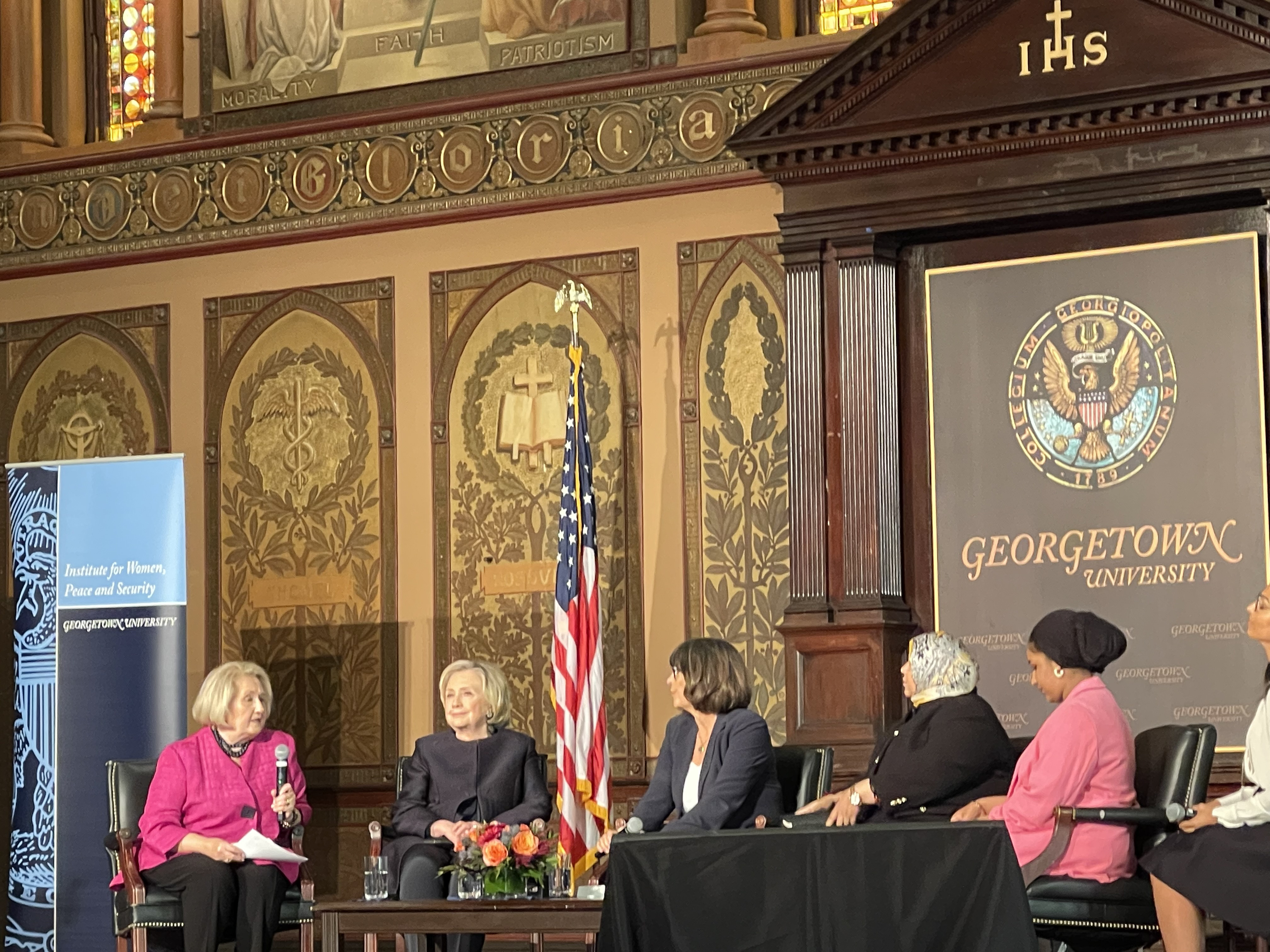
Secretary of State Hillary Clinton chose Gaston Hall today as the venue to introduce a wide-ranging set of policies aimed to protect women and institutionalize their voices around the world.
The first-ever National Action Plan on Women, Peace and Security lays out five steps for cooperation and action among numerous governmental agencies to increase women’s security in zones of conflict and implement their voices in government and peacekeeping operations around the world. President Barack Obama issued an Executive Order that directed for the plan’s implementation earlier this morning.
Clinton emphasized, “women are not just the victims of war. They are agents of peace.” Accordingly, the first area of the National Action Plan emphasizes partnering with women in vulnerable regions and countries to prevent conflict before it begins. Women’s health and security issues are often “canaries in the coal mine”, said Clinton, and can act as “early warning systems” to not only highlight where women are being oppressed, but where conflict is likely to occur in the future.
When armed conflict does break out, the second prong of the National Action Plan is designed to strengthen and expand efforts to protect women in conflict zones. Clinton said the plan will compel American diplomats and humanitarian workers across the globe to reach out to “political leaders and local influentials” and “poorly trained soldiers and police” in efforts to combat the use of rape as a war tactic and to provide adequate aid services to women.
The US government will also work to reach out to men and boys at all levels of society to end discrimination—including combating tribal and religious-based gender discrimination. Clinton said that many of these efforts will remain sensitive to local norms and cultures, but “you must draw lines in certain areas.” “Beating women is not cultural,” the Secretary said. “It is criminal.”
Read the rest of this entry »
2 Comments »
When 83-year-old Detroit-born poet Philip Levine spoke in Gaston Hall yesterday evening, the event was part of a the Kalmanovitz Initiative for Labor and the Working Poor’s “Labor Lab” series. Levine, who is currently serving as the United States’s Poet Laureate for 2011-2012, was chosen for this series because of the famous and compelling poetry he has written about his years spent working at various industrial jobs in Detroit. However, Levine, who left industrial work for academia over five decades ago, made it clear that he is not the poetic mouthpiece of the American worker.
“I’m nobody’s voice,” he said. “I’m me.”
This kind of attitude about poetry and his success at it, whereby writing a good poem is more akin to getting struck by lightning than to consciously trying to make a political statement, characterized Levine’s entire speech, which was also, despite his sometimes heavy subject matter, punctuated with multiple moments of humor (hearing an octogenarian say “bullshit” into a microphone is always good for a laugh or two). Levine’s talk, which also included a discussion with NPR book critic and Georgetown critic-in-residence and lecturer Dr. Maureen Corrigan, left the audience with the idea that our Poet Laureate is not only an immeasurably gifted writer, but also a pretty cool guy.
Levine alternated speaking about his life, family, work, and inspiration with readings of selected poems from his collections. The first three of these poems—entitled “Fear and Fame,” “Coming Close,” and “What Work Is”—all chronicle different experiences of the Detroit industrial worker. “What Work Is” proves particularly effective, as it delivers images of men waiting in line for work, their isolation from their families, and the devastation they feel when the man in charge decides not to take any workers “for any reason he wants.” Reading his own poetry aloud, Levine’s vocal inflection was chillingly effective, and further demonstrated why his works about labor are so highly regarded.
The poet also chronicled his transformation from factory worker to academic, which he decided to do when an uncle told him to “live on [his] wits.” He was a professor of English at California State University, Fresno, and said of the experience that “teaching was not like working.”
“You sat there and lied to people,” he continued with a laugh. “It was a gas!”
Read the rest of this entry »
2 Comments »
On Friday afternoon, former President Bill Clinton (SFS ‘68) spoke at Gaston Hall, and reflected on the current economic and political state of the country. His speech was part of the “Clinton-Gore Economics: Understanding the Lessons of the 1990s” symposium, which highlighted economic successes that the speakers attributed to the Clinton administration’s policies and leadership.
The symposium consisted of two panel discussions in addition to Clinton’s keynote speech. The panelists, including top officials and political players during the Clinton administration, addressed the 1993 budget battle and how the Clinton administration treated education, technology, transportation, and other issues within the larger economic plan. They also highlighted the important role that investment played during his administration.
The panelists and the former president also spoke about the country’s balanced budget during his second term, as well as the drops in unemployment numbers and number of people on welfare during his administration, the latter of which decreased from 14.1 million to 5.6 million. They argued that the administration’s policies played a measurable role in changing the economic state in which the country had been during the previous decate.
Clinton, however, noted that the policies made during his administration were not prescriptive. “As you look at the problems that the President faces today, the members of Congress face today, I would like to first state the obvious,” he said. “The particular solution we pursued is not appropriate to this particular moment because the problem is different.”
However, he did say that some of the philosophies that shaped the policies under his administration remain relevant today.
“Abraham Lincoln said that in America, it was good to have wealthy people because it fostered innovation and creativity and effort in the rest of us,” Clinton said. “On the other hand, as an economic matter, we all need to pitch in and do what we can so that those of us who had all of the gains of the last decade [and in the 1980s], just as I did, should make a contribution. That’s a contribution we can make.”
Read the rest of this entry »
2 Comments »
Continuing this year’s parade of political (or just politically-minded) figures coming to campus, the University announced today via email that former President Bill Clinton will coming to campus this Friday, October 28, for a symposium entitled “Clinton-Gore Economics: Understanding the Lessons of the 1990s.” The event is in conjunction with the William J. Clinton Foundation, which aims at, according to its website, “alleviate poverty, improve global health, strengthen economies, and protect the environment” through partnerships and collaboration.
The event will also include two panel discussions, entitled “The Foundation: The 1993 Budget Fight and the Beginnings of a New Economy,” and “The Bridge: Harnessing the Innovation of the 1990s.” Notable participants include former Secretary of the Treasury Robert Rubin, Vice President Joe Biden’s Chief of Staff Bruce Reed, Former Secretary of Housing and Human Development Henry Cisneros, and Georgetown University President Jack DeGioia.
Apparently, the University has decided to avoid the mob scene that was last year’s Obama line, and has instead chosen to give out tickets by lottery. Students must register for the lottery sometime before 7:00 p.m. tomorrow, and will be notified on Wednesday morning if they have been chosen. Winners are each allowed to bring one guest, who must be a current Georgetown student, staff member, or faculty. The event runs from 12:00 to 2:30 p.m., and anyone who cannot attend the entire event is asked not to register.
No Comments »
After 14 years in the United States House of Representatives and approaching 15 years in the Senate, double Hoya and Illinois Senator Richard Durbin (D-IL, SFS ’66, Law ’69) seems to really take the Georgetown motto of “men and women for others” to heart. The senator spoke for about 300 students a packed Gaston Hall the evening of Tuesday, October 18, in a lecture hosted by the GU College Democrats, and struck a careful balance between humor and gravity to engage his audience.
He started by recounting his own time as a Hoya. He was studying in the library when news arrived that President Kennedy had been assassinated and “everything came to a stop.”
From there, he discussed the way Georgetown students witness “the march of history right before [their] eyes” because the school is “so close to the decision-making that literally changes the world.”
Durbin also offered words of encouragement to the portion of the audience that remains undecided about the future—apparently, the senator didn’t know what he wanted to do with his life as a second-semester senior at Georgetown.
He took an internship his then-senator of Illinois, Paul Douglass, where he became enthralled with American politics and coincidently acquired the nickname, “Dick,” that has followed him since. The first person to call him Dick was Paul Douglass, and he certainly did not want to correct the senator. “The name stuck,” Durbin said.
But Durbin’s road to office was anything but smooth. After three straight losses, he was finally elected to the House of Representatives in 1987.
As a senator, Dick Durbin has been an active force behind the DREAM Act, which seeks to make it easier for illegal immigrants who have been U.S. residents for most of their lives to attend college.
He recounted the story that first impassioned him to become involved with the issue. Chicago has a Merit Music program, which provides instruments to underprivileged schools. The program has been immensely successful—100% of participants go on to college. His office received a call one day that a young Korean woman and concert pianist could not afford college because, although she had lived in the U.S. since the age of two, she was technically not an American citizen.
Read the rest of this entry »
13 Comments »
Yesterday morning, while most Hoyas were still warm in their beds, others were lining up outside Gaston Hall at the crack of dawn, hoping to get a seat for a speech by one of the nation’s biggest political figures. The speech they were waiting for was by Secretary of State Hillary Clinton, who spoke at 8:30 a.m. for the opening address of the U.S.-India Higher Education Summit.
“Democracy depends on education,” Clinton said of the importance of the summit, which marks the first time that the world’s two largest democracies have come together to discuss what she believes to be the crux of their political systems.
Also present for the summt were Minister of Human Resource Development in India Kapil Sibal, Assistant Secretary for South and Central Asian Affairs Robert Blake, University President Jack DeGoia, and 300 presidents, chancellors, and other important educational figures from the U.S. and India. Because of all the high-profile guests, only about a hundred of the students who lined up were allowed seats, and those lucky hundred were relegated to the balconies of Gaston.
Clinton began her remarks by welcoming the students in attendance. She took the chance to make a plug for careers in the Foreign Service—considering the sleep that most sacrificed to be there, her message probably did not fall on deaf ears.
She then outlined the United States’s commitment to collaborate on issues of higher education with India.
“Investing in education is in our common interest,” she said.
She continued by saying that education is a “passport to understanding,” along with building international relationships and the importance of “looking outward” in the world that we now inhabit.
Read the rest of this entry »
2 Comments »
A politician is coming to Georgetown! And no, this time it isn’t one of those drop-ins from the Vice President that we’ve gotten so accustomed to. Instead, as the opening speaker for the U.S./India Higher Education Summit, which takes place at Georgetown on Thursday, October 13, Secretary of State Hillary Clinton will be speaking in Gaston.
The purpose of the summit, according to its website, is to “provide a platform for government and education leaders from both countries” to discuss their ideas about education and plans for its betterment with a “broad cross-section” of audience members, including academics, administrators, and NGO executives. Other notable speakers Indian Minister of Human Resources Kapil Sibal, U.S. Secretary of Education Arne Duncan, and Indian Ambassador to the United States Nirupama Rao, who spoke on campus in September. Ribal will be joining Clinton in making the Summit’s opening remarks.
Rao isn’t the only one of the summit’s speakers who is familiar to the Hilltop. Clinton two years ago to discuss Obama’s human rights agenda, and Duncan was here in May 2010 to discuss the role of parents in education.
After Clinton and Ribal’s opening ceremonies, the summit will continue throughout the day, with events including a roundtable and plenary session in Gaston Hall, and a speaker’s luncheon on Healy Lawn. Duncan will make the closing remarks, again joined by Ribal, in Gaston at 5:00 p.m.
For those who can’t make it out of bed and to Healy at the appropriate time—which we’re sure is going to be very, very early—the summit’s events will be broadcast online from Georgetown’s webcast site.
4 Comments »
During his lecture on Friday afternoon, filmmaker and author Michael Moore demonstrated an acute sense of his audience and location. Not only did he acknowledge that Georgetown has been or will be host to such conservative figureheads as Karl Rove and Ann Coulter, but he drew a political parallel that would make Hoyas from any corner of the political spectrum crack a smile. When discussing the voting patterns of young people, he explained why so few 18- to 25-year-olds bothered to vote in the 2010 midterm elections.
“[Obama]’s been playing it like Georgetown football,” he said. The crowd erupted with laughter, whoops, and applause.
That kind of situational awareness was a big part of what made Moore’s presentation, entitled “Here Comes Trouble: An Evening with Michael Moore,” so engaging. During the lecture, which was sponsored with its share of public chagrin by the Georgetown Lecture Fund, Georgetown Program Board, and the Student Activities Commission, Moore was equal parts cynically joking and unsettling serious as he discussed public policy, Christian values, and America’s financial and social woes. He structured the entire evening with such a smooth narrative arc and call to action for young people to repair the nation that it reminded the crowd why he has an Oscar lying around somewhere in his house.
Since he is, of course, the maker of such politically-minded, left-bent films as Farenheit 9/11 and Sicko, Moore spent a good deal of the speech addressing the what he believed to be the flaws and hypocrisies inherent in America’s version of “21st Century capitalism.” He launched into this by bringing up the recent Occupy Wall Street campaign, and expanded into the mortgage crisis, job crisis, and other financial woes by summing up the problem with a single, unifying source.
Read the rest of this entry »
9 Comments »
|