Posts Tagged “Georgetown Solidarity Committee”

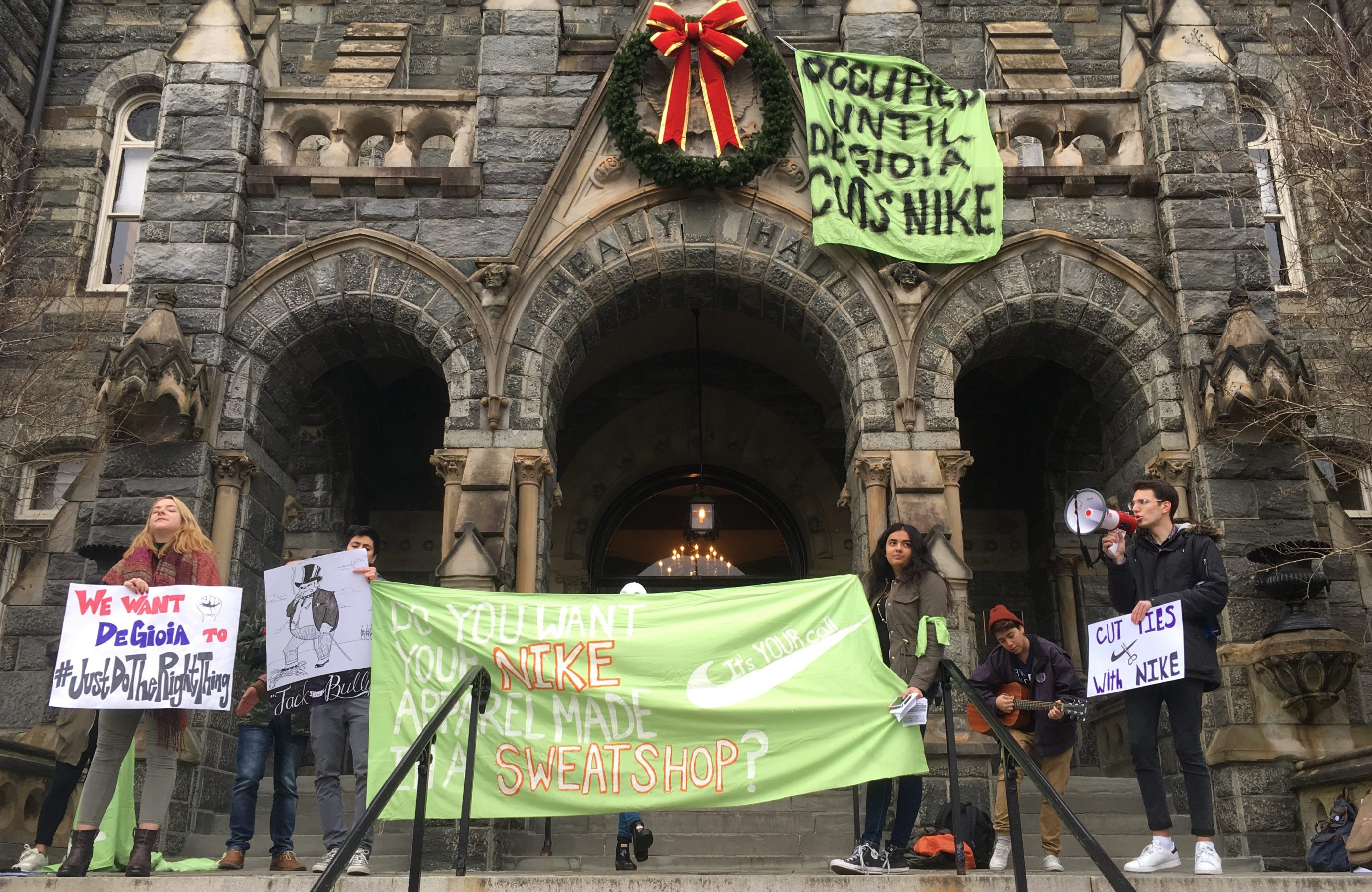
IMG_1849Georgetown’s Licensing and Oversight Committee recommended Friday that the University terminate its sportswear contract with Adidas no later than December 15, due to the company’s mistreatment of workers at an Indonesian factory.

The LOC is a board of students and administrators who make recommendations to the president president “regarding the University’s relationships with the collegiate products and apparel industry stakeholders.” The group gave the recommendation three weeks after members of the Georgetown Solidarity Committee delivered a letter and petition to President John J. DeGioia asking the University to put pressure on Adidas by ending the contract.

172 students signed the second petition. This is not the first time GSC delivered a letter and petition to President DeGioia, and the second action was part of an effort to remind the University that students are not stepping down from the issue.

“This is an important step in a campaign that has been going on for over a year in response to Adidas’ mistreatment of workers at a factory in Indonesia,” GSC announced in a press release. “Adidas violated Georgetown’s Code of Conduct for Licensees, as well as Indonesian labor law by failing to pay $1.8 million in legally owed severance to the factory workers of PT Kizone.”

Cornell University decided not to renew its contract with Adidas as well in mid-September. The university’s president David Skorton released a letter stating, “We believe that severance is a basic worker’s right as are a living wage, freedom of association and safe working conditions,” according to the Cornell Sun. Last week, Oberlin College also agreed not to renew its contract. Oberlin and Cornell are the only universities as of yet in the country to sever their ties with Adidas.

Read the rest of this entry »

Comments 1 Comment »

IMG_1849Early Friday afternoon, members of the Georgetown Solidarity Committee delivered a letter and petition to University President John J. DeGioia’s office asking the administration to cut its sportswear contract with Adidas if the company does not reform its labor practices.

The issue at hand is severance pay for Indonesian workers. Solidarity members say Adidas is withholding back wages owed to employees.

“Adidas had a factory called PT Kizone in Indonesia and two other companies, Nike and Dallas Cowboys, also operated in this factory,” Natalia Margolis (SFS ‘13) said. “They closed the factory and now Adidas is refusing to pay the workers … a severance.”

Julia Hubbell (COL ‘15) says this practice not only puts Adidas at odds with Indonesian law, but violates the University’s licensing agreement.

“There is a specific clause in that contract that says companies need to pay all applicable back wages, meaning specifically severance,” she said. “That gives Georgetown University every right to either demand Adidas change its behavior or cut the contract.”

Friday was not the first time GSC has asked the University to pressure Adidas. The group delivered a letter to the administration last spring, but the results were unsatisfactory to the activists.

“We had a letter delivery last year,” said Margolis. “Georgetown has sent letters to Adidas, but the response hasn’t been enough … They don’t want to set precedent that they’re going to do this.”

Read the rest of this entry »

Comments 1 Comment »

Last Saturday, amid the frenzy of GAAP weekend and the annual Run for Rigby event, Georgetown’s Grilling Society wasn’t the only group serving burgers and hot dogs in the 85 degree heat. Across from the long lines for GUGS burgers in Red Square, members of Georgetown Solidarity Committee set up tables and a grill on Healy Lawn for a barbecue with on-campus workers. The event was also cosponsored by GUSA and the Advisory Committee on Business Practices for the first time in the barbecue’s history.

GSC members hold this event each semester to give students a chance to interact with workers outside of the traditional service environment. “It’s fun, a lot of students played with workers’ kids and it was just a fun, informal atmosphere,” Rachel Milito (SFS ’12), a member of GSC, said. “It’s important to show appreciation for all the work that workers do on campus that often goes unnoticed, but more importantly it’s a forum for workers from different parts of campus to get together and see if they’re having similar experiences and have a sense of solidarity.”

Compared to past semesters, this semester’s barbecue had much higher attendance rates. “It was mostly Leo’s workers and Public Safety officers. We reached out beyond that but that was the best turnout we’ve had at a BBQ before,” Samuel Geaney-Moore (SFS ‘12) said. “It was nice that that GUSA cosponsored it, and some of the members of the Advisory on Business Practices came as well, which is more than we’ve got in the past.” Geaney-Moore pointed to the campaign negotiations for the union as a significant source of bonding between the students and workers.

In light of the recent firing of two Leo’s workers, the conversations at the barbecue inspired the workers to arrange a meeting for Thursday to outline the rights of a worker. “If you don’t speak up we don’t know what’s going on. You can’t wait till you get fired. The union can only protect you if you have a job. If you don’t have a job, what can you do? A lot of people don’t understand their rights. Because of the picnic we’re going to have a meeting on Thursday to outline those rights,” Tarshea Smith, Leo’s employee and member of the Unite Here! Leo’s branch Worker Committee, said.

Read the rest of this entry »

Comments 3 Comments »

On Sunday, Georgetown Occupy organized a teach-in in Red Square, inviting speakers of various backgrounds to spread awareness about income inequality. Held in response to the Wall Street Training Boot Camp taking place on campus for aspiring investment bankers and other members of the financial sector, the Occupy event also attracted students from American University and members of the greater D.C. community.

The day of events included a discussion of the dangers of Wall Street risk-taking, income inequality, a symbolic cleansing of the American flag, and a Georgetown Chimes appearance that started as a counter-protest but ended as a group dialogue on Jesuit ideals.

Georgetown Solidarity Committee kicked off the event by explaining how the University can enact a policy of socially responsible investment by dissociating itself from undiscerning corporations as well as by supporting corporations that do promote the greater good.

The first two guest speakers of the day, Sarah Anderson of the progressive think tank the Institute for Policy Studies and Bart Naylor, a financial policy advocate at the consumer interest lobby Public Citizen, responded most directly to the Wall Street Training Bootcamp across campus. Anderson, while acknowledging that certain financial sector jobs are vitally important, asserted that Wall Street has grown entirely too large. The system of rewarding risky ventures and high-frequency computerized trades, she said, could cause another financial collapse.

Naylor addressed Wall Street’s relationship with legislators. He reported that for every lobbyist on the side of the consumer, the financial sector has 150, the type of disparity that accounts in part for the power of banks.

Read the rest of this entry »

Comments 16 Comments »

On Thursday, many workers at Leo’s, who are in the process of negotiating a new contract with Aramark after successfully forming a union, staged a brief demonstration on the cafeteria’s upper floor. On Vox, Hoyas sounded off on the most egregious disturbance to campus peace and quiet since an angry President DeGioia learned that Leo’s did not serve sloppy joes. You can head over to the post linked above for the full back and forth; here we’ve selected a few of our favorites.

Mother Jones noted the allegiance of our favorite besweatered card-swiper (to be confused with Suru and Umberto):

Ripai knows which side HE’S on!

Vox has it on good authority that Hoya also hates children and Li’l Sebastian:

I hate Solidarity Committee.

typical clearly has no idea that we are a weekly. How typical:

I’m sick of the Voice cheerleading for Gtown Solidarity. It should just change its name to the Daily Worker and be done with it.

Frequent commenter asuka offered the best solution we’ve heard yet to the Leo’s workers’ contract issues:

Robots. Humanoid robots would solve this problem.

Comments 2 Comments »

Shortly after 12:30 p.m. today, Leo’s workers, who are in the process of negotiating a union contract with Aramark, staged a demonstration on the upper floor of the dining hall. Coinciding with chicken-finger Thursdays and a day when Aramark managers are on-site, the unionizing workers demanded a fair contract from their employer. Joined by many members of the Georgetown Solidarity Committee, the brief demonstration ended to applause, with chants of “We’ll be back!”

Comments 36 Comments »

In this week’s feature, Gavin Bade examines the Georgetown Solidarity Committee’s fight for the rights of workers on the Hilltop:

The Living Wage Campaign counts as one of Solidarity’s greatest successes. According to Georgetown professor Michael Kazin, a scholar of progressive movements, GSC is uniquely influential—not only in the way it attracts attention to social justice issues, but in the tangible, identifiable changes it has affected in the community.

“Sometimes people in progressive movements mistake their presence, their demonstrations, their protests, themselves for making change,” said Kazin, himself a former member of Students for a Democratic Society. “On the other side of a protest, the other side of progressivism, you’ve got to change people’s lives. If you don’t change people’s lives, then at some level it’s just rhetoric.”

In light of President Obama’s signing of the National Defense Authorization Act, Editorials critiques the wide gap between his administration’s rhetoric on civil liberties and the reality of its policies.

In News, Amy Liu discusses the University’s final defense, submitted Friday, of its 2010 campus plan.

In the Sports pages, Tim Shine analyzes where the Hoyas disappointed against St. John’s and Depaul, and how the next three weeks will likely make or break their season.

In the Leisure section, Heather Regen raves about Nomadic Theatre’s A Night of One-Act Plays, which opens tonight at 8 p.m. on the Devine Studio Theatre stage in DPAC.

Meanwhile, Page 13 caricatures the University’s happy acceptance of a $20 million donation from Saudi Prince Alwaleed, who reportedly employs dwarfs as “jesters”.

Linking problems of social justice to the lack of education equity, Patricia Cipollitti calls for universal access to excellent education in Voices.

Comments No Comments »

On Tuesday evening, the Lannan Center for Poetics and Social Practice, the Georgetown Solidarity Committee, and the GU College Democrats presented “I am Troy Davis: The Execution of Troy Davis and the Death Penalty” to a full house in Copley Formal Lounge. Featured speakers included Davis’s sister Kimberly Davis, cofounder of the Campaign to end the Death Penalty and death row exoneree Lawrence Hayes, author, activist, an filmmaker Jen Marlowe, and director of Amnesty International’s US Death Penalty Abolition Campaign Laura Moye.

Troy Davis was convicted and sentenced to death in 1991 for the 1989 murder of a man in Georgia. Since his trial, all but two of the 34 witnesses who testified against him have recanted their testimonies. Davis was scheduled for execution three times, but due to too much doubt surrounding his guilt they were delayed up to his final execution on September 21, 2011. His trial and death sparked sadness, outrage, and demonstrations around the world calling for a change in the justice system.

Kimberly Davis emphasized the human aspect of the trial and execution for her family. She shared stories of her brother’s faith, his love for his family, and how he wanted them “to continue his legacy, to continue to prove his innocence, and to show that there are flaws in the death penalty.” While the twenty years that Troy Davis spent on death row were difficult, Kimberly Davis emphasized the bond that formed because of them.

“Throughout the years our family just grew closer and closer,” she said.

Lawrence Hayes, who was awaiting execution in a prison on New York in the 1970s until Furman vs. Georgia abolished the death penalty in the state, noted that “we need to show more sense of appreciation, value, and respect for life”.

The other speakers urged Georgetown students to get involved in shaping the American judicial system and other social movements. Suggestions included joining the death penalty abolition movements in Virginia and Maryland and establishing an Amnesty International club on campus.

Photo by Max Blodgett.

Comments 3 Comments »

A new group that is made up of several student clubs at Georgetown is pushing the University administration to selectively divest in companies that perpetuate human rights abuses in Israel and Palestine or profit from the Israelis’ presence in Palestine.

Georgetown, Divest!, which includes clubs like Georgetown Student for Justice in Palestine, Georgetown Solidarity Committee, the Muslim Students Association, and Buddhist Meditation Sangha, according to the group’s Facebook page, will kick off their campaign next Tuesday with a panel including several Georgetown professors and a “a public presentation about Georgetown’s moral obligation to divest from companies that profit from human rights violations and the unlawful occupation of Palestinian territory,” according to a press release from the coalition.

Divest! has already gotten at least one response from the Georgetown administration to their demands. During spring break, Assistant Vice President for Business Policy Planning LaMarr Billups e-mailed the group a letter then Georgetown, Divest! said is “vague” and “does not adequately address the concerns of the group.” In the letter, which Divest! has posted on their blog, Billups clarifies University investment policy.

Members of Divest! will also meet with administrators today. Citing students’ historical success in pressuring Georgetown to divest from Sudan during the Darfur crisis and South Africa during apartheid, Georgetown, Divest! says it will make Georgetown a “relevant player in this grassroots movement for change. SJP encourages the Board of Trustees to acknowledge Georgetown’s commitment to social justice and human rights.”

Comments 6 Comments »

4173254758_f4612b0413

“O come let us demand now, O come let us demand now, O come let us demand now that DPS get fair pay!”

That’s something you may have heard sung by members of the Georgetown Solidarity Committee if you happened to be walking through Red Square on Wednesday afternoon. The line—sung, you may have guessed, to the tune of “O Come All Ye Faithful”—is from one of five songs that members of Solidarity wrote to the tune of popular Christmas carols, demanding a wage increase for Department of Public Safety officers.

The group is currently in the middle of a campaign to get the University to agree to a pay raise for Department of Public Safety officers as Georgetown negotiates with the Allied International Union. So far, Solidarity members have written an open letter to President John DeGioia demanding the wage increase and have held at least one rally.

Now, they’re singing.

Several of the songs demonize Senior Vice President Spiros Dimolitsas, like this one, sung to “Rudolph the Red-Nosed Reindeer”:

Spiros, our senior vice president
Had a very pointy schnoz (Like Pinnochio)
Grew every time he spoke of
Supporting the workers’ cause (What a hypocrite!)

All of the other admin
liked what they were being paid (A whole lot!)
They never let DPS officers
Make what they deserve each day (Like a living wage!)

Then one sunny autumn day
The workers had their say: (Rise up!)
“Spiros with your cufflinks bright,
Give us what we’re owed tonight!”

All of the students joined them
And they shouted out with glee: (Solidarity!)
“Spiros, our senior vice president
Don’t be such a bourgeoisie!” (PAY YOUR WORKERS)

Solidarity is known for staging high-profile campaigns for their various social justice causes (such as fasting until Georgetown janitors were given raises and trespassing on military bases during anti-military rallies). But after the jump, you’ll find there’s nothing quite like hearing GSC promise that “Worker power’s comin’ to town.”

Read the rest of this entry »

Comments 18 Comments »